About
Welcome to Perspective in Motion
A farmer in Punjab buries his son, who drank pesticide after the cotton failed.
A weaver in Bengal folds up a loom his family ran for four generations, because a powerloom shirt costs less than his thread.
An elder in the Niyamgiri hills won't eat a mango before the seed inside it has matured. Eating it early kills a tree that hasn't been born yet. The company at the foot of the hill has no word for this.
A twenty-three-year-old sits on the floor across from me and says, "main thak gayi hoon, par kisi cheez se nahi." I'm tired, but not from anything.
An economist can account for the first. An ecologist for the third. A psychologist for the fourth. Each account is correct. Each one is also a wall around the thing I'm trying to see.
The thing isn't inside any of those disciplines. It shows up in the space between them, where nobody is trained to look and no budget line exists.
That space is what I mean by the metacrisis.
We keep trying to understand what is happening to us using categories we were handed. Our economics. Our sciences. Our idea of what counts as knowledge. Our sense of what a person is for. Maybe the answers aren't the problem. Maybe the instruments we're asking with are too small for what we've pointed them at. Those instruments feel like plain common sense rather than one civilisation's set of choices, and that is what I mean by conditioning. It was installed early enough to feel like our own opinion.
There is an inside to this that gets discussed least. What happens in a person when the world outside changes faster than the categories inside can keep up? That is the tiredness that isn't from anything. It has no name yet, so people carry it as a private failure.
The questions underneath
-
Can we build different institutions without reproducing the old human patterns?
-
Why do the patterns of domination keep coming back, whoever is holding the power this time?
-
Whose knowledge counts as knowledge, and who decided?
-
What is civilisation actually for? What happens when it loses its memory?
-
How much of what we call reality is an assumption we've mistaken for nature?
-
Who do we become when the world stops making sense?
I don't have settled answers and I've grown suspicious of people who do.
This site is where I work on the questions in the open. Reporting from villages and small towns nobody sent a reporter to. Essays written while I was still lost in the middle of something. Poetry in Hindi, because a few things refuse to sit down in prose.
It's called Perspective in Motion because I don't trust a fixed position, including my own. The questions I carried when I started are not the ones I'm carrying now. I'd rather show you the movement than perform a consistency I don't have.


Describe your image
About Me
My Journey
I dropped out of an MBA in 2010.
Not dramatically. I sat in a classroom being taught how to grow something forever on a planet that isn't growing, and I couldn't make the two facts share a room. Everyone around me had made their peace with it. I hadn't, and one day I stopped pretending I had.
That was the first refusal, and it set the pattern for everything after.
Like most people who leave, I began with resistance. Something is broken, name it, fight it. That fire was right and I haven't lost it. But resistance on its own started to feel like a full time job with no destination. Somewhere on the road I understood that tearing down and building are not two separate shifts. You do both, and usually on the same day.
Reclaiming education was my first act of defiance. Travelling across India became my way of listening. Unlearning became my deepest practice, and it is the slowest thing I have ever attempted.
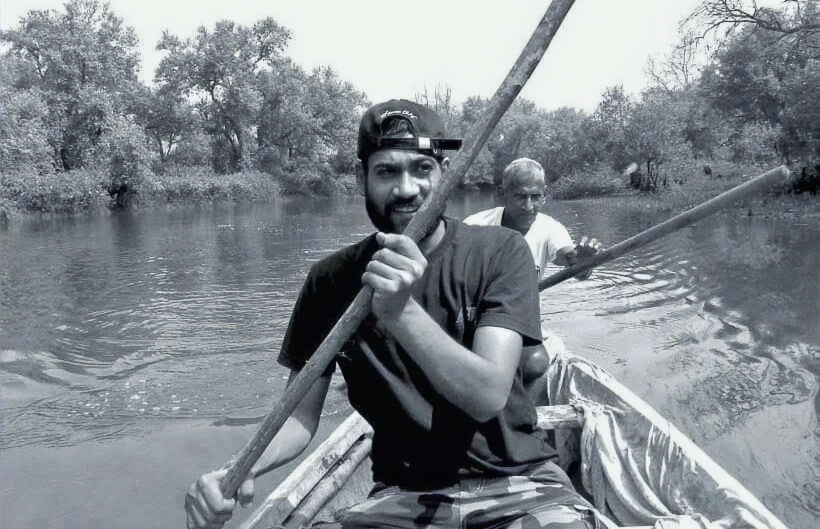
What I met on the road was not what I went looking for. I expected problems. I found people who had already stopped waiting for permission. A farmer in Punjab who lost his son to the debt and went back to seventy indigenous crops anyway. A potter in Haryana who left school so he would never have to leave his village for work that kept him from his family. An elder in the Niyamgiri hills who will not eat a mango before the seed has matured, because eating it early kills a tree that hasn't been born yet. Resilience, loss, and quiet revolutions, in places nobody had bothered to send a reporter.
Slowly I stopped being able to file the crises separately.
They are not only external battles to be won. They are layers of one thing, systemic and intimate at the same time. The social, the emotional and the spiritual do not sit in separate rooms. They meet in how a person actually experiences injustice, and grief, and the possibility of something else. Healing the world and healing yourself turned out to be the same unfinished job, which was inconvenient, because I had been hoping to do only the first one.
What holds through all of it is a handful of words I refuse to let stay decorative. Dignity. Justice. Liberty. Equality. Fraternity. Not ideals to be printed on a wall, but ways of being that either show up in how a room is run or don't show up at all. I have watched them work as the quiet resolve inside an act of resistance, and as the reason somebody keeps going after the act fails.
That understanding is what turned me toward young people. For the last fifteen years I have worked in education, though rarely the kind that happens in classrooms. My work is with young people the system had written off before they arrived, mostly rural, tribal and Dalit, mostly in Hindi, mostly far from where policy gets written. What I try to build with them isn't information. It's the capacity to see the conditions they are living inside, and then to act on them. Transformative leadership, if you want the phrase for it, though I care less about how they lead a project than about how they navigate a life.
Outside of paid work I've organised with the Narmada Bachao Andolan and with Vikalp Sangam, held weekly gatherings and reading circles and street reclaiming walks with Pink City Feminists, and helped build a community space from nothing. None of it paid. Most of it formative. I also studied at Swaraj University as a self designed learner, which is the only education I would call formative, though I have a degree that says otherwise.
I keep peeling back inherited narratives, and I keep arriving at the same two questions. What new ways of being are possible? Which stories need rewriting before anything else can move?
Perspective in Motion is where I do that peeling in the open. It's a space where justice and healing are allowed to be the same subject, and where the stories don't settle. They search. The long road is from separation toward interbeing, and I think the movement itself is where new worlds start.
A note on how I write. I'm an oral thinker. My ideas begin out loud, usually to somebody patient, and I use AI to help shape spoken thought into written form. The thinking is mine. The writing is a collaboration. I say this plainly because a site about honest narrative ought to be honest about itself.
Fifteen years in, I hold the same suspicion I walked out of that classroom with in 2010, only now I have evidence. And there is one thing I still haven't resolved. Whether the work is to change how people see, or to change who holds the land. I do the first for a living. I believe the second matters more. I haven't yet made those two things one sentence.
Storyteller, mentor, witness. Mostly someone still walking, and still asking.
The work itself lives on Work in Motion.


